Independent evidence reviewReviewed by Andreas Torgersen · BSc Finance, BI Norwegian Business School
MarketInsiderLab independently identifies the company or security behind promoted stock pitches and checks material claims against SEC filings, company disclosures and other primary public evidence. Identification is separate from any judgement about whether a security should be bought or sold.
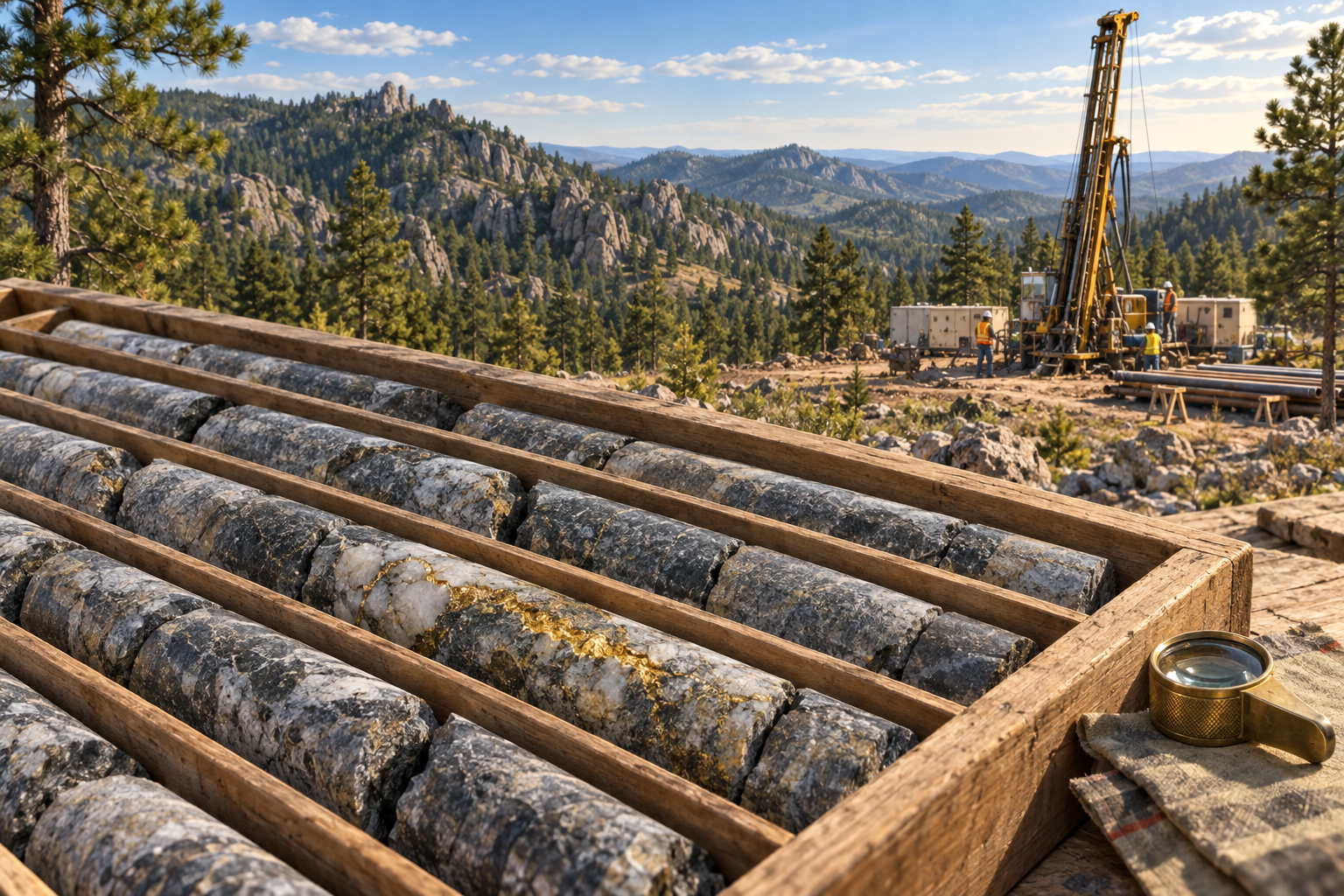
Exploration, not production. Conceptual illustration by MarketInsiderLab, created with AI.
Teaser decoded · reviewed September 19, 2026
Whitney Tilson’s “Gold Led Me to Mount Rushmore” teaser most likely refers to Dakota Gold (NYSE American: DC). The company fits the Black Hills location, roughly $6 share price and unusually specific 114-ton gold figure. Its technical reports describe a substantial resource. The promotion moves too quickly from that resource to the money shareholders might eventually make.
1A distinctive numerical match3.6533 million troy ounces convert to about 113.6 metric tonnes, close to the advertised 114 tons.
2The geography fitsRichmond Hill and Maitland sit in South Dakota’s historic Homestake District in the Black Hills.
3Development is advancingRecent metallurgical work supports further study of a heap-leach project, not an operating mine.
4Cash flow is still conditionalPermits, engineering, construction funding, recoveries and gold prices remain consequential.
Identification: High confidence, based on independently matched clues. This review does not claim that the publisher confirmed the ticker in the material inspected. It covers Dakota Gold, not every company mentioned in the broader resource-technology presentation.
Evidence, not enthusiasm
Teaser credibility breakdown
6.75/10
Clue fidelity1.75/2
Identity fit2.00/2
Business evidence1.75/2
Claim realism0.75/2
Risk context0.50/2
What drives the score
The campaign has preserved publisher provenance and a distinctive numerical resource match.
Issuer studies support a serious development project, with substantial technical work still ahead.
The wording blurs a geological estimate with extracted gold and future earnings.
Large historical gains elsewhere and institutional ownership do not establish DC’s future returns.
Five evidence factors, each scored out of two. The credibility score is separate from editorial quality and is not an investment rating.
PRICE AROUND THE PROMOTION
What happened after this stock was promoted?
DC
13 Aug 2026–29 Sept 2026
Latest verified close · USD$6.2129 Sept 2026
● DC daily closeP Earliest MIL-recorded campaign traceE Publisher emailD Decoder published
Since earliest mil-recorded campaign trace+6.52%14 Sept 2026 close → 29 Sept 2026 close
Since decoder published-2.05%21 Sept 2026 close → 29 Sept 2026 close
Marker dates, evidence and price sources
P · 12 Sept 2026 · Earliest MIL-recorded campaign trace This is the campaign date preserved in MIL’s monitoring record, not proof of the publisher’s original launch. It does not imply that the promotion caused a price move. Closing-price reference: $5.83 on 14 Sept 2026 (next trading session).
E · 18 Sept 2026 · Publisher email Closing-price reference: $6.11 on 18 Sept 2026.
D · 20 Sept 2026 · Decoder published Verified WordPress publication date in Europe/Oslo time. Closing-price reference: $6.34 on 21 Sept 2026 (next trading session).
Same-day close is a daily reference, not the event’s intraday price. Publication does not redefine the earlier promotion marker.
Historical price changes provide context, not evidence of research skill or promotion-driven returns. Split-adjusted closes exclude dividends and are not total returns. This dated snapshot is not a live quote or investment recommendation.
Get every Decoder by email
One promotion decoded. A repeatable way to check the next one.
Stock Teaser Decoder subscribers receive every new Decoder by email, including selected subscriber-only editions:
The most likely company and our identification confidence.
The important promotional claims checked against original sources and company disclosures.
The evidence gaps, business risks and independent Decoder Verdict.
US$49/month · Delivered by email · No login required · Cancel anytime
The free signup covers one next public edition and includes consent to occasional research emails. Local pricing and any applicable VAT are shown on the subscription page. Independent research, not investment advice or a promise of returns.
What Tilson is promoting
The campaign uses a trip to Mount Rushmore to introduce a little-known gold company in the surrounding Black Hills. A Stansberry-originated email dated September 18, 2026 repeats the roughly $6 stock clue, names BlackRock and Vanguard as holders, and attributes the opportunity to new technology. It then broadens the pitch to a nationwide resource boom, citing gains of 227%, 378% and 773% in other stocks.
An attributed sponsored placement retained from September 14 adds the more useful clue: “114 tons of gold.” The same family was already circulating on September 12 in an advertisement explicitly presented on behalf of Stansberry Research. These are observed circulation dates, not proof of the campaign’s original launch.
The email says the video gives away a stock name. This review does not depend on that promise being fulfilled: the distinctive clues can be tested independently.
Why Dakota Gold is the strongest fit
Campaign clue
Independent check
Weight
Gold project in the Black Hills
Dakota Gold locates Richmond Hill near Lead, South Dakota, in the historic Homestake District.
Strong geographic match
114 tons of gold
The February 2025 estimate lists 3,653,300 measured-and-indicated ounces in heap-leachable material: approximately 113.6 metric tonnes.
High-specificity numerical match
Stock trading around $6
DC closed at $5.81 on September 11 and $6.11 on September 18.
Consistent, time-sensitive
Large future earnings opportunity
Dakota Gold has published an initial economic assessment for Richmond Hill, while remaining a developer.
Thesis fit; earnings not established
The resource calculation uses the issuer’s February 6, 2025 disclosure and the standard troy-ounce conversion. The advertisement does not define its unit. The close fit is to metric tonnes, not U.S. short tons, so the conversion supports identification without making the wording exact.
Coeur Mining is a credible geographic alternative because it owns the nearby Wharf mine. But Coeur describes a diversified producer with seven operations, not a small developer centered on Richmond Hill. Barrick is another recognizable name in the district, yet Dakota Gold’s property disclosures identify Barrick as the option counterparty. Neither offers the same combined fit to this resource number, development story and approximate stock price. DC is the clearly strongest candidate.
The 114-ton claim: resource, not recovered gold
A mineral resource is an estimate of mineralized material under specified geological and economic assumptions. It is not a pile of metal, an audited inventory ready for sale or automatically a mineral reserve. Dakota Gold’s disclosure expressly distinguishes resources from demonstrated economic viability.
That distinction changes the reading of the advertisement’s verb “unearthed.” The company has delineated mineralization through drilling and technical work. It has not reported extracting 114 tonnes of saleable gold. Recoveries, dilution of the ore, mine design, cut-off grades and costs determine how much material could eventually become profitable output.
Nor was the estimate new in September 2026: it was disclosed in February 2025. The fresh promotion is presenting an existing resource story alongside subsequent development progress.
What the economics actually say
Dakota Gold’s July 7, 2025 initial assessment modeled 2.6 million ounces produced over 17 years under its measured-and-indicated plan. It estimated $384 million of initial capital, including contingency, and a $1.6 billion after-tax net present value at a 5% discount rate using $2,350 gold.
Those are study outputs, not cash on the balance sheet. A project valuation is also not an equity valuation: funding terms, royalties, corporate costs, timing and any new shares issued affect what existing shareholders retain. The assessment supplies a basis for discussing potential scale. It cannot establish the promotion’s annual cash-generation claim as a dependable outcome.
The latest technical progress is meaningful, but preliminary
The September 10, 2026 metallurgical update reported oxide-column gold extraction ranging from 57.3% to 92.0%, with a 74.2% unweighted average. The strongest result should not be applied to the whole deposit. The company says commercial assumptions still need scale-up and operating allowances.
Its stated sequence is a pre-feasibility study in the fourth quarter of 2026, a feasibility study around mid-2027 and production as soon as 2029. Each is a target. The technical program supports further engineering; it does not remove permitting, financing or execution risk. The release documents conventional drilling, assays, metallurgical testing and process design. It does not establish that one proprietary breakthrough has made profitable extraction inevitable.
Cash funding and dilution deserve equal billing
The June 30, 2026 Form 10-Q reported $99.3 million of cash, a six-month net loss of $16.8 million and operating cash use of $15.5 million. Shares outstanding rose from about 114.1 million at year-end to 134.1 million at June 30, roughly 17.5%.
The February offering helps explain the improved liquidity: raising capital strengthened the company’s funding position while increasing its share count. Cash available for current work should not be mistaken for a fully financed construction budget. The earlier capital estimate materially exceeds June cash, and later studies may revise it.
Claim check
Promotional framing
Assessment
A substantial Black Hills gold discovery
Supported in substance. A disclosed resource and active development program exist.
114 tons have been unearthed
Misleading if read as extracted metal. The numerical match is a resource estimate.
Hundreds of millions of dollars a year
Conditional. Study economics do not establish operating earnings or shareholder distributions.
New technology unlocks certain wealth
Unproven. Better information and processing studies still leave commercial uncertainties.
BlackRock and Vanguard are loading up
Not established as a current accumulation claim. A dated holding alone would not prove recent purchases, active conviction or future performance.
Other stocks’ triple-digit gains imply similar upside
Unsupported inference. Different companies and selected periods are not a reproducible forecast for DC.
What could change the assessment?
Engineering: the next study’s mine plan, recovery assumptions, costs and resource-to-reserve conversion.
Funding: a credible construction financing package and its effect on ownership, royalties and obligations.
Permitting: actual approvals and environmental requirements, rather than an assumed calendar.
Economics: gold-price sensitivity and construction or operating-cost changes.
Execution: evidence that targets are becoming funded, permitted and completed milestones.
A low share price does not by itself mean a cheap company. The share count matters, as does the value the market already assigns to eventual mine development. These are the same questions covered in our guides to reading a 10-K and researching a stock before buying.
Verdict
Dakota Gold most likely answers the teaser. A resource estimate does not answer the investment case.
IdentificationDakota Gold (DC) · High confidence
SupportedDistinctive resource match and real technical progress
UnprovenCommercial output, annual profits and implied returns
The exact numerical fit gives this identification more weight than the general gold-boom story. Dakota Gold has a substantial project and evidence worth examining. The weak point is the promotion’s compression of discovery, mine development and shareholder wealth into one apparently smooth sequence. The missing steps are expensive, uncertain and central to the outcome.
How this review was researched
MarketInsiderLab preserved the original publisher email and attributed campaign circulation, matched distinctive clues, checked alternatives and tested consequential claims against company releases and regulatory filings. Our editorial research standards explain the method. Identification confidence is separate from investment merit.
Sources and image credit
Stansberry Research / Whitney Tilson, publisher-originated email, September 18, 2026, “Gold led me to Mount Rushmore”; retained in MarketInsiderLab’s research records.
Hero illustration: MarketInsiderLab, created with AI. A conceptual depiction of exploration, not a photograph of a Dakota Gold property, map, ore-grade illustration or evidence of visible gold in its drill cores.
Disclosure: Independent research for educational purposes. This article is not personalized investment advice, a recommendation or a solicitation to buy or sell any security. Promotional claims, study forecasts and company targets are identified separately from established facts. MarketInsiderLab may update this review as evidence changes.