
Flying corporate jets isn’t just about convenience — it’s about cost. Each flight can run tens of thousands of dollars per hour, and annual ownership can climb into the millions. Those numbers matter, because they turn every trip into a signal worth watching.
💸 What Executive Jets Really Cost
Corporate jets aren’t cheap — and that’s exactly why their movements matter. The price of flying executives from point A to point B isn’t just about convenience. It’s a significant investment, and in many cases, a signal.
In 2024, manufacturers delivered 764 new business jets, according to GAMA. Airplane billings climbed to $26.7 billion, up more than 14% year over year (GAMA, 2025). The growth shows that demand for corporate aviation isn’t slowing down — if anything, it’s accelerating.
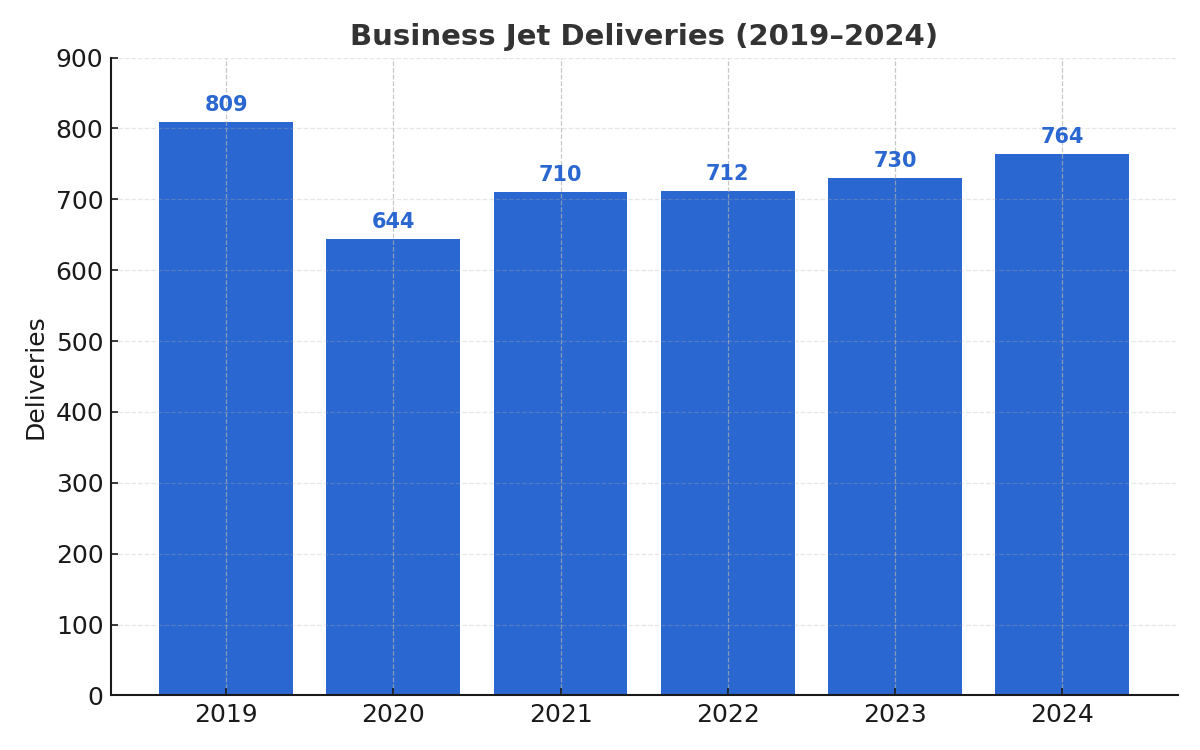
What stands out in this chart is how resilient corporate aviation has been. After a sharp drop in 2020, when deliveries fell to just 644 during the pandemic, the industry quickly recovered. By 2023, deliveries climbed back to 730, and in 2024 the total reached 764 new business jets — the highest since before COVID.
For investors, that steady growth matters. It shows that demand for corporate aviation isn’t just cyclical; it’s accelerating. Every new aircraft delivered expands the network of jets in use, which in turn creates more opportunities to detect unusual movements and the signals they can carry.
The cost of actually using these aircraft is just as striking. Typical flight costs in 2024 ranged from about $6,800 per hour for smaller turboprops to nearly $19,000 per hour for long-range jets (Forbes, 2024). And that’s just operating time. Fixed costs like crew, maintenance, hangar fees, and insurance often run into the millions. A Gulfstream V, for example, can rack up $2M+ annually in fixed costs before a single flight hour is flown (Global Air Charters, 2025).
When companies are willing to commit this kind of money, every unusual flight has weight. These movements aren’t casual. They represent intentional choices — the kind of choices that can hint at what’s happening behind the scenes, long before a filing tells the rest of the market.
📊 Corporate Spending on Executive Jet Travel
The costs aren’t abstract — they show up directly in company filings. In 2022, S&P 500 companies reported spending roughly $65 million on executives’ personal use of corporate jets. That figure was nearly 50% higher than before the pandemic, according to the Wall Street Journal. It’s a reminder that executive aviation is not just an operating tool, but also a significant corporate perk.
Some companies stand out even more when you look at the details. Tyson Foods, for example, disclosed $2.98 million in fiscal year 2024 for its chairman’s personal jet use — almost three times the $1.07 million recorded the year before (Axios, 2025).
Meta has been another headline case. In 2022, the company reported $6.6 million in spending on private flights for Mark Zuckerberg and Sheryl Sandberg — a 55% increase compared to 2019 (Business Insider, 2024).
Numbers like these highlight a simple point: when companies are willing to spend millions on moving executives around, those movements aren’t random. They’re deliberate — and often aligned with moments when strategy, negotiations, or external pressure demand absolute control of time and privacy.
✈️ What Investors Often Overlook
For most people reading proxy filings, executive jet use looks like a luxury line item. It’s easy to dismiss it as just another corporate perk. But that view misses the real point.
At $15,000 an hour or more, no corporate flight is casual. These jets aren’t dispatched for leisure — at least not when the bills are signed off at the board level. They’re used to move decision-makers when timing, privacy, and control matter most.
What’s overlooked is how these movements often cluster around critical events. Mergers and acquisitions. Quiet meetings with activist investors. Conversations with regulators or advisors at neutral airports. These aren’t destinations executives choose by accident.
The market tends to focus on filings, but filings are lagging. By the time a deal is disclosed, the planes have already flown. That’s why watching how and where executives travel can offer a different perspective: it turns a line-item expense into an early signal of what might be unfolding inside the company.
🕵️ From Cost to Signal
When you put the numbers in perspective, the logic becomes clear. If a flight costs upwards of $15,000 an hour and annual ownership runs into the millions, executives aren’t using these jets on a whim. Every movement is intentional.
That intentionality is what makes flight activity valuable to investors. A corporate jet showing up at a new location, or overlapping with another company’s aircraft at a neutral hub, isn’t just aviation trivia. It’s the trace of a strategic choice — and sometimes the earliest visible sign of a deal, a campaign, or a shift in direction.
Seen this way, corporate jet usage stops being a footnote in a proxy statement and becomes a piece of signal intelligence. It doesn’t replace filings or financials, but it adds a dimension that arrives earlier — before the market reacts.
🏆 Conclusion: High Costs, High Signals
Corporate jets are among the most expensive tools a company operates. They cost millions each year to maintain, and tens of thousands of dollars for every flight hour. That scale of spending means one thing: executive travel is rarely routine.
For investors, these costs aren’t just about perks. They’re about intentional movements that can coincide with the most important moments in corporate strategy — from deal talks to regulatory negotiations. Watching where and when these flights happen can surface signals that filings won’t reveal until much later.
At MarketInsiderLab, that’s exactly what we track: corporate jet movements filtered for context, and layered with disclosures and lobbying data, so that the noise falls away and the early signals stand out.
Want to compare brokerages? Best place to buy stocks Forex, Commodities, Indices
Top 5 List
Find the best online trading platform in our top 5 ranking list.
