
Geopolitical headlines often move faster than fundamentals. This article separates direct asset-level exposure from narrative-driven price moves — so you can see what would actually change, and what wouldn’t.
Whenever Greenland resurfaces in the news — especially in connection with U.S. strategic interests — a familiar market pattern follows. Rare-earth stocks begin moving together, narratives spread quickly, and distinctions between direct exposure and thematic association blur.
When geopolitical stories hit markets, stocks often move first — and exposure is sorted out later.
This article is not about predicting whether the United States will ever take control of Greenland. It’s about something more practical — and more often misunderstood:
If such a scenario were to occur, which publicly traded companies would actually see a material change in exposure — and which would not?
Jump to section Tap to expand/collapse
One-Screen Summary: What Changes — and What Doesn’t
Scenario vs. Exposure Type
A structural classification — not a prediction of outcomes.
| Scenario | Changes Fundamentals | Moves on Headlines |
|---|---|---|
| Companies with Greenland assets | ✅ Yes | ✅ Yes |
| USAR / MP Materials | ❌ No | ✅ Yes |
| Theme-adjacent stocks | ❌ No | ⚠️ Briefly |
What “Exposure” Actually Means
In market commentary, exposure is often used loosely. For clarity, MarketInsiderLab applies a narrow, asset-based definition.
MarketInsiderLab definition: A stock has direct geopolitical exposure only when a political outcome would change asset ownership, licensing, permitting, or long-term resource control reflected on the balance sheet.
Anything else — policy alignment, strategic relevance, or thematic fit — is indirect.
That difference matters.
Want to observe headline-driven moves — without risking money?
If you’re tracking how narratives like this can impact price action, use a demo simulator to practice execution mechanics and volatility awareness — not to “prove” a thesis.
- See how fast markets reprice around headlines
- Practice order types, sizing, and risk limits in a virtual environment
- Build the habit of separating story momentum from asset-level reality
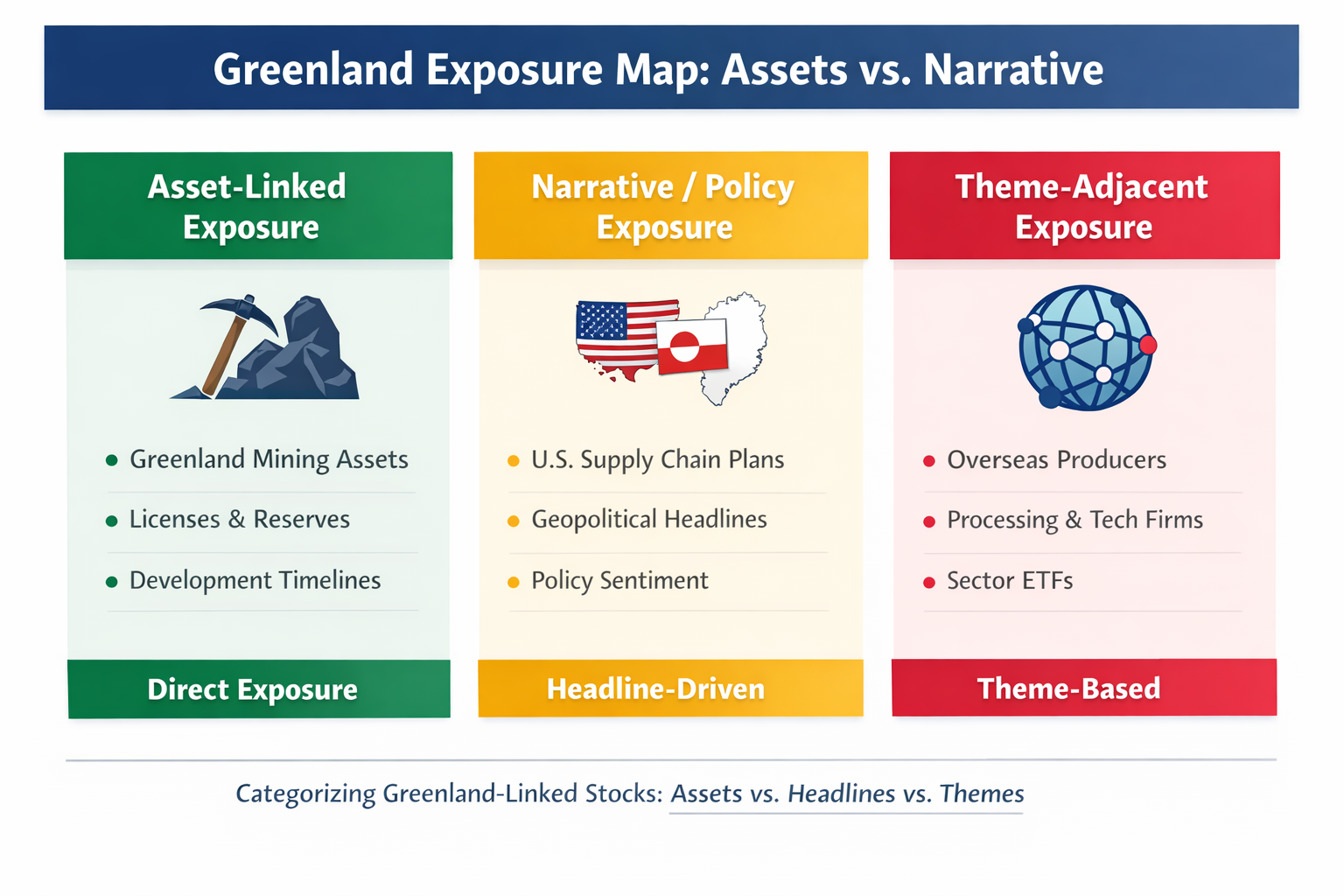
Greenland Exposure Map: Assets vs Narrative
To make the distinction concrete, Greenland-related stocks generally fall into three structural categories:
This framework is useful whenever geopolitical stories drive broad sector moves before asset-level verification.

Category 1: Stocks With Direct Greenland Exposure
These are the companies whose assets or development prospects are physically tied to Greenland. If permitting or governance changes, fundamentals can change.
These are the companies whose assets or development prospects are physically tied to Greenland. If governance, permitting, or strategic oversight were to change, their fundamentals could change as well.
Critical Metals Corp. (NASDAQ: CRML)
Critical Metals controls the Tanbreez rare-earth project in Greenland, one of the world’s largest undeveloped rare-earth deposits.
Because the asset itself sits in Greenland, any structural shift in political control, regulatory posture, or strategic prioritization would directly affect:
- Development timelines
- Capital access
- Long-term asset valuation
This is real exposure — not thematic association.
Energy Transition Minerals (ASX: ETM)
Formerly Greenland Minerals, Energy Transition Minerals holds the Kvanefjeld project, a large rare-earth deposit with uranium byproducts.
The project’s trajectory has been shaped primarily by Greenland’s domestic mining policy. A change in governance or regulatory framework would materially alter the project’s outlook.
Again, exposure here is asset-based and direct.
Other Greenland-Focused Explorers (Early Stage)
Several early-stage mining companies hold exploration licenses or development-stage assets in Greenland. While their exposure is real in a geographic sense, these companies remain highly sensitive to permitting, financing, infrastructure constraints, and political outcomes.
Examples often cited in this category include:
- Amaroq Minerals (TSX.V: AMRQ) — primarily focused on precious-metal exploration in Greenland
- Greenland Resources Inc. (OTC: GRLRF) — development-stage iron-ore project
- Ironbark Zinc (ASX: IBG) — advanced-stage zinc-lead-silver project with Greenland exposure
These companies illustrate direct geographic exposure, not certainty of development or economic viability.
Because most remain pre-production or capital-constrained, their share prices tend to react sharply to policy headlines — in both directions.
Category 2: Stocks Often Mentioned — But Indirectly Exposed
These companies are frequently linked to Greenland narratives despite having no operating assets there.
These companies are frequently linked to Greenland narratives despite having no operating assets there.
USA Rare Earth (NASDAQ: USAR)
USA Rare Earth is positioned around a U.S.-based rare-earth and magnet-manufacturing strategy, focused on building a domestic supply chain.
It is often mentioned alongside Greenland because:
- Greenland headlines are framed as “U.S. securing rare-earth supply”
- USAR fits neatly into that strategic narrative
What changes: Market sentiment.
What does not change:
- No Greenland reserves
- No licenses or concessions
- No immediate change to cash flows or resource ownership
USAR’s valuation is therefore more sensitive to policy framing than to geological outcomes.
This is narrative exposure — not asset exposure.
MP Materials (NYSE: MP)
MP Materials operates the Mountain Pass mine in California and already sits at the center of U.S. rare-earth and industrial-policy discussions.
Because of that positioning, MP often moves alongside broader rare-earth headlines.
But structurally:
- MP has no operations in Greenland
- Greenland outcomes do not alter its reserves, cost structure, or production profile
As with USAR, any reaction would be sentiment-driven rather than fundamental.
Category 3: Stocks With No Meaningful Exposure (But Still Mentioned)
These companies may react briefly to headlines, but Greenland outcomes do not affect their balance-sheet fundamentals.
In many market discussions, companies are grouped into the Greenland narrative based on thematic proximity rather than geographic or operational linkage.
This often includes:
- Rare-earth producers with operations entirely outside Greenland
- Companies focused on processing, separation, or downstream technologies
- Broad materials or critical-miner exposure captured through sector baskets
Examples commonly pulled into this category include:
- Lynas Rare Earths (ASX: LYC) — a major rare-earth producer with assets in Australia and Malaysia
- Ucore Rare Metals (TSXV: UCU) — focused on processing technology and North American supply chains
- Select rare-earth or critical-miner ETFs
These companies may react briefly to Greenland-related headlines, but there is no structural mechanism through which Greenland outcomes alter their asset base, production profile, or long-term economics.
Any price response in these cases tends to reflect theme momentum rather than exposure.
Why Markets Blur These Lines
Geopolitical stories compress complexity into simple themes:
- Rare earths
- China dependence
- National security
Markets respond quickly to these frames, particularly in sectors where supply chains are opaque and timelines are long.
But the pattern is consistent: Geopolitics changes narratives overnight — assets change balance sheets over years.
Prices often reflect the former long before the latter is verified.
The Takeaway
If the United States were ever to take control of Greenland, only a small subset of publicly traded companies would experience direct, fundamental exposure.
- Direct exposure comes from asset ownership and licensing
- Indirect exposure comes from policy narratives and investor perception
- Most stocks discussed in this context fall into the second or third category
When stories move faster than filings, separating exposure from association becomes the edge.
This article is intended as a reference for distinguishing asset-level exposure from narrative-driven price moves in geopolitical market coverage.
Join our FREE 4-part Decoder Briefing
See how popular stock promotions are built — and where the story quietly breaks. You’ll receive our forensic framework immediately, followed by a real example where we identify the stock being promoted and test whether the narrative holds up against filings, positioning, and incentives.
- Part 1: The Decoder Framework (how to audit any pitch)
- Part 2: How “strategic narratives” create false certainty
- Part 3: A real decode example (ticker identified + claims tested)
- Part 4: The decision filter (what to watch, what to ignore)
Free. Unsubscribe anytime. Educational content only — not investment advice.
FAQ
Does this article predict the U.S. will take control of Greenland?
Why do USAR and MP move on Greenland headlines if they have no assets there?
Are early-stage Greenland explorers “better exposure” than U.S.-based rare-earth names?
Does a change in control or influence over Greenland automatically affect all rare-earth stocks?
Educational analysis only. This article does not constitute investment advice.